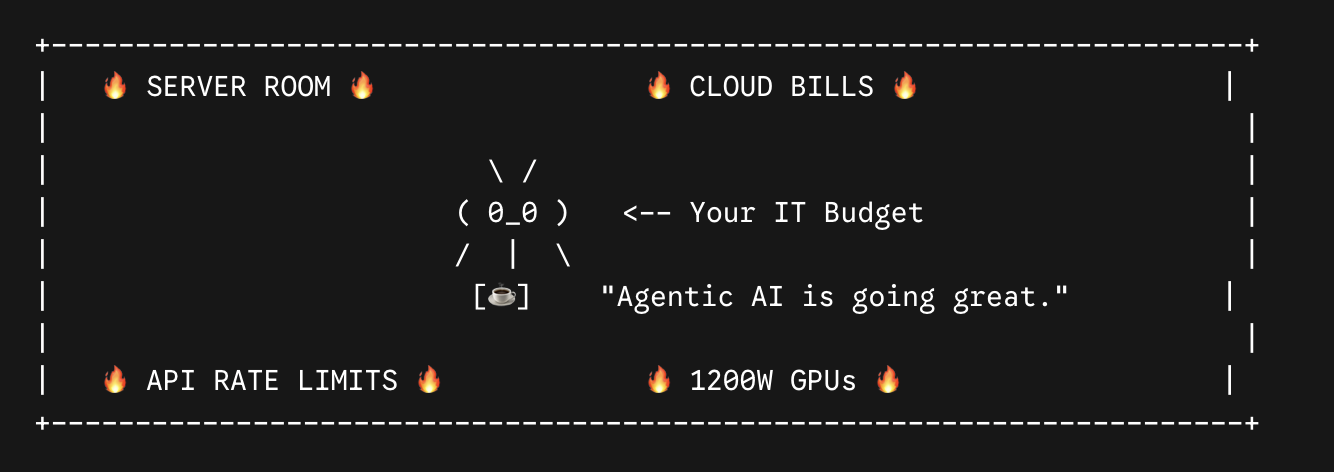
The artificial intelligence narrative has shifted dramatically. The breathless euphoria of the early generative AI days has given way to a sobering period of financial calculation and structural reality. Organizations and investors are no longer asking, “What can AI do?” They are asking, “How much will this actually cost, and when does it pay off?”
As the massive capital expenditures required to sustain the AI boom continue to mount, significant financial and operational risks have emerged. Yet, despite these headwinds, a collapse of the AI market is highly unlikely. AI is settling into a phase of painful maturation, transitioning from a hype cycle into foundational infrastructure.
The Financial Precipice: ROI and the CAPEX Explosion
The most immediate risk facing the AI industry is purely economic. The hardware, energy, and talent required to train and run frontier models have created an unprecedented capital expenditure (CAPEX) burden.
- The Infrastructure Bill: Cloud providers and hyperscalers are spending hundreds of billions of dollars on GPUs, data centers, and power agreements. This massive outlay requires them to pass costs onto enterprise customers. As computing resources become constrained, the “AI tax” on enterprise software and cloud computing services continues to rise.
- The ROI Deficit: Many enterprises jumped into AI adoption without clear governance or budget caps. Now, the bill has arrived. Consumption-based pricing models – where companies pay per API call or token – are draining IT budgets. Businesses are finding that broad, generic AI deployments often fail to generate the promised return on investment (ROI). The gap between what AI costs to run and the actual revenue it generates is currently the industry’s most precarious fault line.
- Macroeconomic Ripple Effects: Financial institutions, including the Bank for International Settlements (BIS), have warned that the concentration of capital in AI poses broader market risks. If enterprise adoption slows due to cost fatigue, or if the anticipated productivity gains take a decade instead of a year to materialize, the resulting market correction could be severe.
Beyond the Balance Sheet: Energy and Operational Risks
The risks of the AI buildup extend far beyond financial spreadsheets, threatening physical infrastructure and operational security.
- The Power Grid Bottleneck: AI data centers consume significantly more electricity than traditional cloud infrastructure. The shift toward “agentic AI” – systems that autonomously chain tasks together – requires exponential increases in compute power. We are reaching physical limits where power grids in key data center hubs simply cannot support the projected demand, leading to delayed deployments and intense environmental scrutiny. See whats happening in Ireland.
- Security and Data Poisoning: As AI is woven into critical business processes, it becomes a prime attack vector. “Prompt injection,” data poisoning, and model inversion attacks are moving from theoretical academic papers to active threats. Furthermore, the risk of corporate data leakage via third-party LLMs remains a persistent headache for Chief Information Security Officers.
- The Hallucination Liability: In high-stakes environments like healthcare, legal, or autonomous systems, the stochastic nature of AI (its tendency to confidently invent facts) is a massive liability. Companies are discovering that the cost of building safeguards, human-in-the-loop review systems, and insurance against AI errors can sometimes outstrip the savings of automation.
The Anchor: Why AI is Here to Stay
Given these staggering costs and risks, it is tempting to view the AI buildup as a fragile bubble destined to pop. However, AI is fundamentally different from speculative assets or fleeting tech trends. It is sticking around for three undeniable reasons:
1. Genuine, Measurable Productivity Gains
While broad, company-wide AI deployments struggle to show ROI, targeted use cases are delivering undeniable results. In software engineering, AI copilots have drastically reduced boilerplate coding time. In medical research, AI models are predicting protein structures and discovering drug compounds at speeds impossible for humans. Where AI is deployed as a specialized tool rather than a magic wand, the economic value is real and irreversible.
2. The Shift to “Invisible” Infrastructure
AI is following the trajectory of the internet and mobile computing. It is ceasing to be a standalone product and is instead becoming the invisible engine behind existing software. Operating systems, CRM platforms, and productivity suites are now inherently AI-driven. Businesses will not need to make active choices to “buy AI”; they will simply use modernized software, making AI usage an unavoidable operational standard.
3. The Competitive Mandate
The most compelling reason AI will survive the current friction is evolutionary pressure. If a competitor figures out how to automate 40% of their customer service tier or accelerate their R&D pipeline using AI, opting out is no longer a viable business strategy. The high costs are viewed by many as a necessary survival tax.
The Path Forward
We are not facing the end of the AI boom, but rather the end of the free AI boom. The market is undergoing a ruthless optimization phase. Providers will be forced to develop more efficient, smaller models (SLMs) that don’t require supercomputers to run. Enterprises will stop trying to automate entire departments and will instead focus on high-impact, heavily guarded use cases.
The companies that survive this phase will be the ones who treat AI not as a novelty to be experimented with, but as an expensive, powerful industrial tool that requires rigorous financial and operational discipline.
What will be the choice offered? Lets see!
 Gustaw Fit Blog
Leave a comment